Go Big or Go Home
- Sep 9, 2020
- 6 min read
This week I originally wanted to get a few very rough sketches started for my paintings. When I work on a big piece I always start by creating inspiration / reference boards on pinterest kinda getting an idea of what I will create in my head before I start on paper. I was really into it and feeling super inspired for my sea turtle themed board but when it came to working on the others I could tell I obviously was not as passionate about them.... and found it a lot more difficult to come up with an idea in my head. I feel like the others are much more generic in a way? The coral reef one I was having a better time with tbut the deforestation one I was struggling much more.... I got frustrated and really sat myself down to reflect on what I was feeling/ getting hung up on. So I spent a lot of time focusing on my thesis project and what I wanted it to be, look like, feel like, and the feelings / messages that people got from the piece.
I came to the conclusion that rather doing 3 pieces, (6 paintings, each piece being made of 2) that I rather focus all of my time and energy one one much large piece (2 paintings). Going down from 3 to 1 will give me a lot more budget to get a very large screen, I am aiming for a 60 - 70 in TV now meaning the paintings will be between 52 x 29in to 61x34in.
I really want to go big for several reasons....
1. I just keep feeling very strongly it is what I want to do.
2. I think a larger painting will get more people's attention, be more immersive (with all the details and more complex scene) , and thus be more memorable.
3. I want this piece to take some time to destroy and being larger will take long as well as I want it to be an experience that more people can partake in together/ at the same time.
I feel like I can deliver a much better, more powerful, and more polished piece overall by going in this direction, and I feel a lot better about the project as a whole now.
While also looking around the internet I found Obey Giant's site. I have seen the "Obey" stencil and words on many things in the past few years but never knew exactly what it was (besides trendy). After reading a lot on the site and looking at several pieces I think I will pull from these examples as I think they are great for showing how large scale works can be so much more captivating and even in your face -bring important messages to the front of viewers mind and staying there.


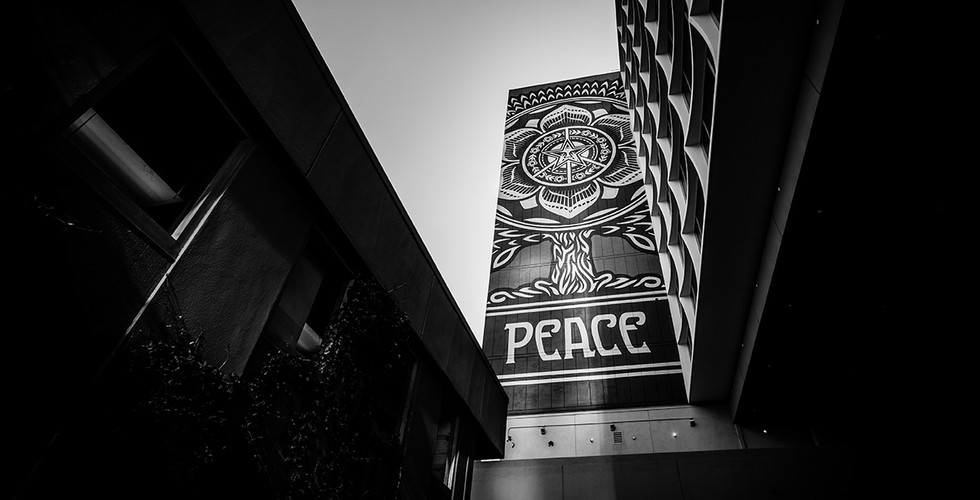
Based on my personal experience large pieces I have seen in museums and galleries have always stuck with me. I believe that large pieces are more memorable. I will touch on this in my thesis paper but just looking around for more examples I found this link here of some pretty classic examples.
While looking more into painting large I found a few things that were interesting and helpful. I found two very different artists that had a list of a few tips for painting large. Alisa Burke and Byrne Smith, both have used Acrylics and have worked on large paintings.


I ended up not getting the TV's or protective glass yet because of this change in ideas greatly affects what I need for materials. I wanted to get my advisors' opinions, especially before I go buy a insanely huge TV. I need to buy the TV before I can get the protective glass material to cover it. Once this new version/idea is approved I will start looking to get those items.
However I was getting very anxious about the whole how will the paint work / peel/ chip off of the glass like material so I did a little experimenting. I used black Artist's Loft Paint and Dawn dish soap and painted some test 'swatches' on glass bottles. I was very surprised to find that the paint that had soap with it actually applied thicker than the straight paint did. The soap also gave the paint a very glossy almost rubbery appearance. I did one bottle with equal parts paint/soap ratio and then the other bottle with more paint than soap.

The mixture that had equal parts had a lot more bubbles than the other, but after doing a few layers this wasn't really a problem. It also took a much longer time to dry... and in the end felt very oily and you could actually just smudge the paint right off, with your finger. It also stained your hands which I like the implication of for my message but don't think guests would appreciate. Plus I feel like handling them without ruining them would be close to impossible. - it was the same next day
The mixture that had more paint than soap scraped off very easily but did not come off from rubbing like the previous mixture did. It dried with a very waxy look/feel.- on the next day it still came off just as easily
The paint that had no dish soap also was able to be scratched off and surprisingly I think this way had the best effect. It was not difficult but took more effort and left more bits behind that you'd have to go back and scratch off more. -on the next day it was a bit harder to come off but still did
Originally I got this idea from a scratch off polaroid project DIY I saw, which was created for painting on paper - which I also tested the paints on a paper plate - the 50/50 mixture was still wet in some places and was again very oily and easy to rub off, the higher paint content mixture scratched off with little effort and the regular paint did not at all. - But glass is different... the regular paint does come off, so maybe I don't even need soap mixed in, but the painting will have multiple layers of paint... so is there a way it can scratch off in layers or will it just remove all paint?
More testing with layers to be done next week to see if I can get layers to come off one at a time vs all the paint at once. If it does change it i will use a low soap ratio if it doesn't make a difference I will probably use just straight paint!
In the end the material I will be painting on will not be glass, but more like a plexiglass so it may react differently - so I will do a more precise test once I have that.
My thesis statement last week was less the stellar. I found I had way over processed it and brought it down to a dull lifeless sentence that was extremely dry and generic.
So here is my current statement (probably is too personal now?)
In creating a large scale interactive painting that breaks the standard rules and traditions of paintings, I hope to leave viewers with a memorable experience that will stay with them long after the leave the gallery, keeping the thought of how mindless actions we take as humans are negatively impacting our planet.
I changed and have a few more supportive points.
1. Large Scale Art
2. The Power of Touch
3. Art that Changes with Human Interaction
4. Art that is Created to be Destroyed
5. Harmful Mindless Actions
6. Sea Turtles and Light Pollution
Lastly I did some of my thinking at the beach this week which helped me feel even more inspired. I took some pictures of the waves and perspective that I can use for reference in my painting.


Also was helpful for a little R&R, unrelated academically, but very related in truth... I am trying very hard to practice mindfulness and healthier habits this year to positively cope with the major amount of stress, anxiety, and depression I feel. My mental health has always been one of my biggest challenges, it got so bad last year that it caused physical injury, so it is something I really need to manage better this semester.


Comments